
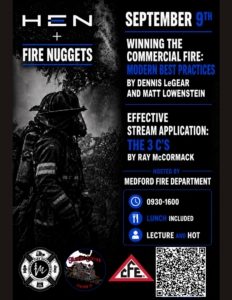
0930-1100 | Dennis Legear Commercial Fire Best Practices, Benchmarks and Actions that are not well known.
Firefighters often hear the phrase, “Do not bring a residential fire mindset to a commercial structural fire,” but the large-volume space fire mindset behind it is not always part of their working knowledge. This class builds understanding of why that statement matters and why many fire departments still approach commercial building fires with primarily residential tactics. Data from the ULFRSI “Coordinated Attack Study” strip mall burns will be discussed and reviewed, with a focus on ventilation and the suppression implications of commercial building construction.
The class will also clarify how commercial fuel-package arrangements complicate water application, mapping, stream selection, and stream positioning. It will include a brief discussion of how reading smoke at a commercial building fire can differ significantly from residential incidents, sometimes giving the incident commander and exterior crews false indicators that the fire is declining when it is actually growing and accelerating.
The class will cover proper pumping practices for large-building sprinkler FDCs, including stepped pressures based on conditions and the effects of area water mains. It will explain what must be monitored, why RPM tracking matters, and when supplying the FDC should be treated as an immediate priority. The discussion will also address reasons to access the roof beyond ventilation cuts, along with how stream geometry and building orientation both exterior and interior affect suppression operations.
Finally, the class will examine the role and appropriate use of three primary mobile-flow options in large-building fires: small handlines (150–185 gpm), large handlines (250–300 gpm), and 500 gpm single-inlet monitors. It will address whether master stream effectiveness depends more on volume or on placement and velocity, and it will challenge the backup-line formula that calls for an equal-or greater line, or one at least one length longer, in commercial operations. Each of these critical elements has a place at commercial fires, and the fire service needs a more detailed discussion of large-volume space fires.
1100-1230 | Ray McCormack Engine Operations: Stream Application
Effective engine company operations begin with getting the right amount of water onto the fire—and applying it correctly. This class examines the principles, techniques, and decision-making required to achieve rapid and complete fire control through effective stream application.
Students will explore the Three C’s of Suppression: Coverage, Cooling, and Contraction, and how each contributes to successful fire attack. The class will examine stream selection and shape, nozzle movement, water mapping, room geometry, positioning, and the most effective methods for applying water from both interior and exterior locations.
Through real world fireground examples, students will learn how stream placement and application affect fire behavior, firefighter advancement, occupant survivability, and overall operational success. The course also addresses common engine company errors that delay extinguishment or place crews at unnecessary risk.
Attendees will leave with a stronger understanding of how to use the hoseline and nozzle as precision tools—delivering water where it is needed, when it is needed, to achieve a faster and more effective knockdown.
1230-1300 Lunch